
The Art of Repellent Marketing
The wrong people not liking you isn't a marketing failure. It's the signal working correctly.

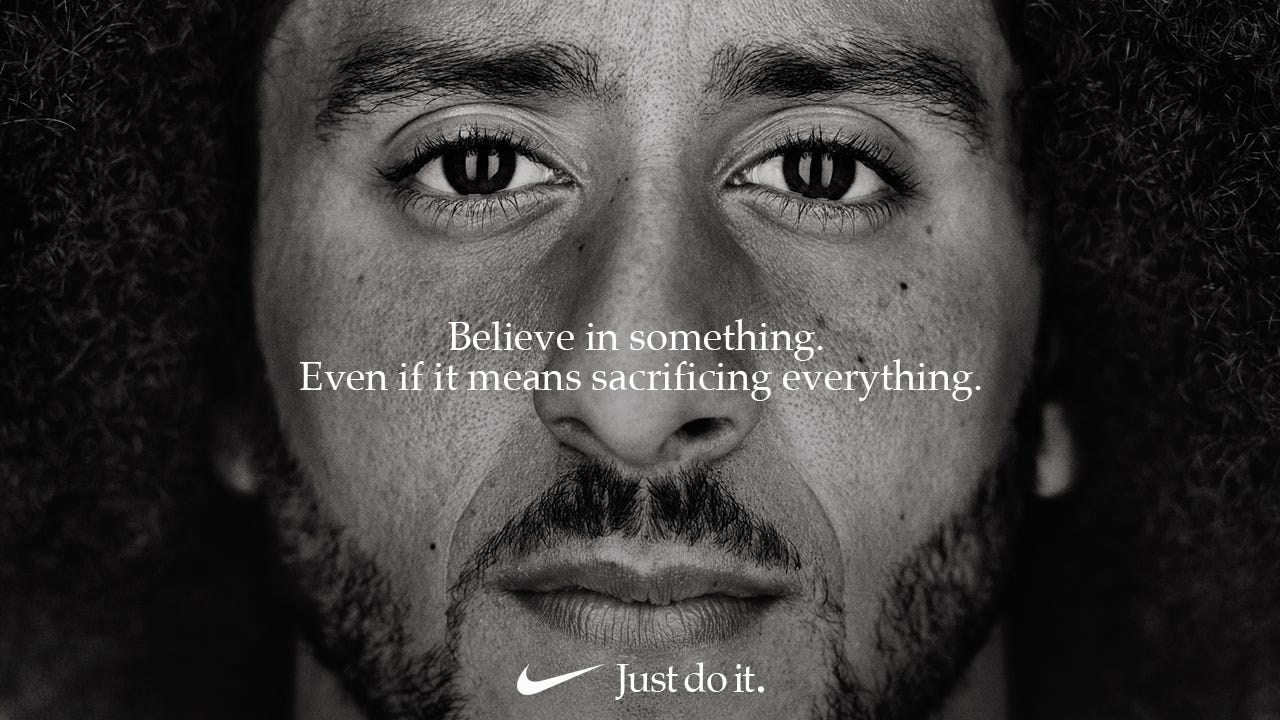
On September 3, 2018, Nike put Colin Kaepernick’s face on an ad with these words underneath it:
Believe in something. Even if it means sacrificing everything.
That’s either the bravest tagline in modern advertising history or a very expensive dare, depending on who you ask. A lot of people felt like answering.
Within hours, Nike customers were filming themselves burning their own shoes. A photo of a pair of destroyed Nike socks went viral. Even the President of the United States weighed in, which is not usually a marketing outcome brands are chasing.
By every visible signal, Nike had made a catastrophic call. Then the numbers came in.
Online sales jumped 31 percent over that Labor Day weekend, nearly double the increase from the year before. By the end of the quarter, revenue was up 10 percent, and North American sales were up 9 percent. When Nike reported those results in December, the stock jumped over 7 percent in a single day, even as most of the market fell.
The people burning their shoes were never Nike’s ideal customer. Nike didn’t lose them. They identified them, told them they didn’t belong, and let them go… for the purpose of connecting more strongly with the customers Nike valued.
That’s essentially the whole lesson. The only tragic aspect of this story is that Colin Kaepernick did sacrifice everything, even though he eventually sparked a movement years later as the murder of George Floyd brought things to a head.
Meanwhile, most business owners try desperately to avoid any situation resembling what Nike did on purpose. And they’re the ones making the mistake.
It doesn’t have to be political or involve social justice. Simply put, you have to stand firmly for something that’s relevant to the problem you solve.
The Paradox of Broad Appeal
Marketing is all about appealing to as many people as possible, right? It feels like math.
More potential clients equals more revenue. Say the safest possible version of your message, and you can’t offend anyone, which means you can’t lose anyone.
Except it works exactly the opposite of that.
Content created to offend no one connects with no one. A message engineered to be inoffensive to everyone is, by definition, engineered to be unremarkable to everyone.
You can’t stand for something in a way that matters to the people who need it most without simultaneously standing against something, in a way that some people really won’t like.
The wrong people not liking you isn’t a marketing failure. It’s the signal working correctly.
Everyone Needs a Villain
Marketing that actually moves people has a villain. Generally, the villain is not a person. Usually, it’s a concept, or the old way of doing things, or a status quo that’s failed the people you’re trying to reach.
When you have a villain, you almost always exclude or repel some people in order to connect with the people you’re after more strongly. Other times, you’re simply naming an “enemy” for your prospects to rally against.
In the first category, Apple ran perhaps the most famous example for four straight years. Justin Long as the cool, creative Mac. John Hodgman as the dorky, virus-prone PC.
Apple wasn’t trying to convince hardcore PC loyalists to switch, because people in that category were never going to. The campaign targeted the much larger group of people who didn’t yet have a strong preference and asked them a single question dressed up as a joke:
Which one of these guys is more like you?
By the end of the first year of the campaign, Apple had sold 1.6 million Macs and had grown sales by 39 percent. The PC nerd never actually had to lose the argument. He just had to make the choice obvious to the “swing buyers” Apple was after.
An example of creating a common enemy takes us back to the 1980s with the Noid, a red-suited creature whose entire purpose was to destroy your pizza before it arrived. He never won, and no one was on his side, because that wasn’t the point.
The Noid dimensionalized a real anxiety: slow delivery and cold pizza, a problem people already had but hadn’t put a name to. Domino’s gave that abstract threat a name, a face, and a catchphrase: Avoid the Noid.
Decades later, Allstate did the same thing with Mayhem, a character who personifies every disaster insurance exists to cover. Nobody wants to think about coverage until Mayhem gives catastrophe a face. And with him standing in the corner, grinning as the tree falls on the car, you understand why you’re paying for the policy.
When you want to stand for something, you should also name what you stand against. And if you end up repelling the wrong audience, that isn’t a side effect of otherwise good marketing; it’s the driving mechanism.
But people still resist. They hesitate to take a strong, clear position out of fear of “losing” someone.
Without that strong message and the resulting villain, though, your fear costs you the best part of the audience you could have not only kept, but also converted into customers and clients.
The Art of Standing for Something
You’ve likely caught on to the fact that you’re not really trying to be repellent. You don’t have to try to push some people away, as long as you actually stand for something.
So why do so many cling to the “safe” message? The one that doesn’t name an enemy, doesn’t ask anyone to pick a side, doesn’t risk negativity in the comment section. It’s tempting because it seems to protect your reach.
It doesn’t protect your reach. It cripples it.
Nike didn’t grow revenue and the stock price in 2018 because they found a way to please everyone. They grew because they were willing to lose customers who didn’t share their values, in exchange for becoming the unmistakable choice for those who would become even bigger fans because of that single ad.
Apple didn’t win over PC loyalists; the “Get a Mac” campaign made them despise Apple even more. But they also made an entire generation of swing users see exactly who they wanted to become, and who they didn’t. The aura of being the “cool” choice spilled over to the smartphone and tablet battles, just in time for Apple to become the largest company in the world for the first time in 2011.
The art of repellent marketing is simply marketing done right. It may be hard to accept at first, but when your messages start to hit with the right people, you’ll see it in action.
The key is to know who you’re repelling, and to do it on purpose. Then watch as everyone else slowly loses the people who matter most while trying not to lose anyone at all.
Keep going-
P.S. Further Premium members are in the process of figuring out what they stand for, who their villain is, and how to build a movement around the people who identify with both thanks to Leading Expert Launchpad. Join us for the course and much more.
further: flashback
🎶 The Bottom Line – Big Audio Dynamite, This is Big Audio Dynamite, 1985 🎶
The first time I heard Big Audio Dynamite, it was The Bottom Line on an awesome mixtape someone made for me in early 1986. By the time I bought the cassette and heard E = MC² a month later I realized, “Hey, this is Mick Jones from The Clash!” Life was different before the internet, kids. (YouTube)
further: sharing
Enjoy this issue? Please forward this email to friends or share by clicking below:
Or you can earn access to Further Premium by recommending Further in general.
Grab your unique referral code here.
Thank you for sharing Further!
Thank you for affirming what I’ve been doing all along and what I believe has been the foundation of my Substack’s success. I had never given it a name before, but I think I have one now: belonging marketing.
I’m not trying to repel people for the sake of being provocative. I’m trying to speak clearly enough that the right women recognize themselves, feel understood, and know they’ve found a place where they belong.
Love it Brian. Stand for something. 💪