
Get Unconventional to Win as a Solopreneur
Choose a genuinely distinct position that makes the right people feel like you’re the only person who really gets it.

Back in 1982, development began on a very different kind of film.
For one thing, only three members of the over 20-member cast were professional actors (and one of them just barely). At times, the dialogue clearly demonstrated that lack of expertise.
In fact, most of the cast were musicians in real life. And while the tunes are definitely exceptional, this is no glorified music video. There’s a real story, with real stakes.
The film was called Purple Rain. And it helped launch its headliner, Prince Rogers Nelson, into that elite stratosphere known as superstardom.
During filming, director Albert Magnoli told Prince he needed one more song for a mid-movie montage that touched on the film’s core theme of recurring relational conflict. Prince delivered two finished tracks the very next day, one of which was called “When Doves Cry.”
Magnoli was delighted. Prince decided the song would also be the lead single.
There was just one all-too-familiar problem.
The record company didn’t like it. Not generally, and certainly not as the lead single that would play a huge role in whether the album and film opened big or not.
“You need to back me with Warner Brothers on this,” Prince told Magnoli. “They said they want me to make it a ‘real’ song.”
Magnoli had no reservations, stating unequivocally, “This is the song.”
You can almost understand why Warner Brothers executives were concerned. “When Doves Cry” is unconventional to say the least, with a stark, almost austere texture that nonetheless captures attention immediately.
Never mind that there’s no bassline, which was pretty nuts for a pop song in the 80s.
Here’s the twist. Prince later revealed that there was a bassline at first, but he decided that with it, the song was too conventional. So he took it out.
His goal was to release a song that sounded like nothing else that was on the radio. He succeeded in more ways than one.
“Nobody believed that this was going to be such a catalyst for the kind of success that it had,” author Alan Light said. “To be able to do something that experimental and that bold, and have it be that popular and connect that universally, it’s just unbelievable.”
The track that was written and recorded by Prince alone in an evening became his very first No. 1 single. It stayed at the top of the U.S. charts for five weeks, and also became a worldwide hit on its way to becoming the biggest single of 1984.
Even more impressive is the enduring recognition. Spin magazine ranked “When Doves Cry” the No. 6 song of all time. It occupies number 37 on Rolling Stone‘s list of the 500 Greatest Songs of All Time. The song is also included in The Rock and Roll Hall of Fame’s 500 Songs that Shaped Rock and Roll.
Not bad for an “unconventional” song that the record company hated. But the truth is, it happens that way more often than you’d think. And it’s not that unbelievable.
Different Is Better Than Better
Most expertise-based business owners try to win by being better.
Better credentials. More experience. Higher-quality deliverables. A longer track record.
All good things, but leading with them puts you in a comparison set with everyone else making the same claims. “Better” is a contest you’re always at risk of losing, because someone can always show up with more credentials, more years, or more case studies.
Author Sally Hogshead put it simply: Different is better than better.
But let me qualify that by saying we’re not talking about being different for its own sake. I mean different in a way that’s meaningful to a specific group of people, that resonates with a shared worldview, a shared frustration, and a shared belief about how things should work.
That kind of difference can’t be copied by adding a credential or undercutting on price. It lives in who you are and what you actually believe.
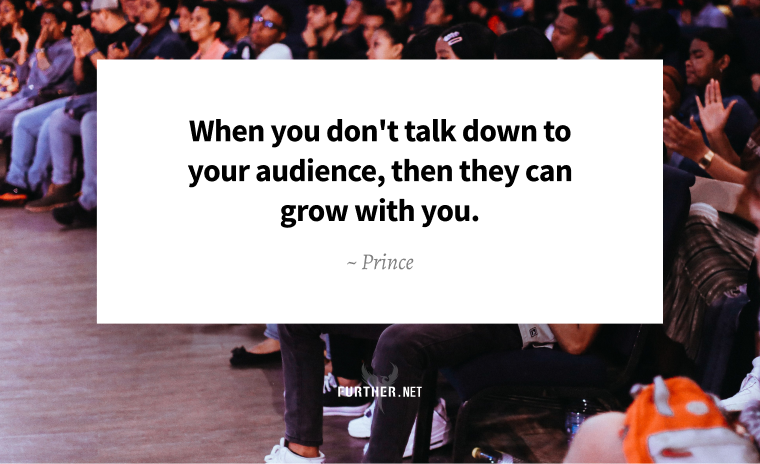
Exactly as with Prince and “When Doves Cry.” Unlike Warner Brothers, Prince understood that the audience could more than handle something they hadn’t heard before.
This is what I call the winning difference. Not the most impressive version of what already exists, but a genuinely distinct position that makes the right people feel like you’re the only person who really gets it.
Sadly, most people and certainly most businesses are more like Warner Brothers than Prince. They default to the conventional approach and prefer to conform to the norm, even as they repeatedly see that the “next big thing” always goes against the status quo.
When it comes to Prince, you might say this anecdote isn’t relevant to you. He was a musical genius, so many people think he was an exception to “the rules.”
While his prodigious songwriting talent and amazing proficiency as a multi-instrumentalist are not in dispute, it’s not Prince’s credentials that made the difference.
Prince chose to be unconventional for another reason. And that was his values.
Values Are Your Foundation
Prince didn’t want to sound like anything else on the radio. He valued that, because it meshed with one of his core values… innovation.
But he also knew that being different led to success. After all, he’d been doing things differently his entire career. And he knew the right people became fans when they encountered what was different about him and his music.
A winning difference does the same thing with your prospects. It doesn’t just describe what you do. It gives people a signal they can act on because it connects to something both you and they value.
This is why positioning that’s built on genuine values outlasts claims about expertise or features. Claims can be countered. Features can be matched.
But values, when they’re authentically yours and clearly expressed, create a kind of recognition in the right people that’s almost instantaneous. These people don’t have to be convinced, because they already believe.
They were just waiting for someone to say it clearly… without that distracting bassline of conformity.
Keep going-
P.S. If you’re ready to find the winning difference for your own solo business, check out Sovereign Startup Foundations. Your unique wiring, your unique expertise, your unique purpose, all wrapped up with AI-augmentation that allows you to do more… as only you can do it.
further: flashback
🎶 Big Country – In A Big Country, The Crossing, 1983 🎶
We’ve left Scotland today on a train for Amsterdam, so it’s only fitting to crank up In a Big Country. Contrary to what many think, there are no bagpipes in this song… the band managed to tune their guitars to sound like them. As for the video, the Scottish Highlands really are that amazing, but what’s in the box? (YouTube)
further: sharing
Enjoy this issue? Please forward this email to friends or share by clicking below:
Or you can earn access to Further Premium by recommending Further in general.
Grab your unique referral code here.
Thank you for sharing Further!
As someone who gets lost even with a GPS when faced with many turns -- Value is that guiding moral compass that helps me navigate this life journey in an ever evolving world environment that keeps blurring the line between what is right and what is wrong. Thank you Brian for sharing this.